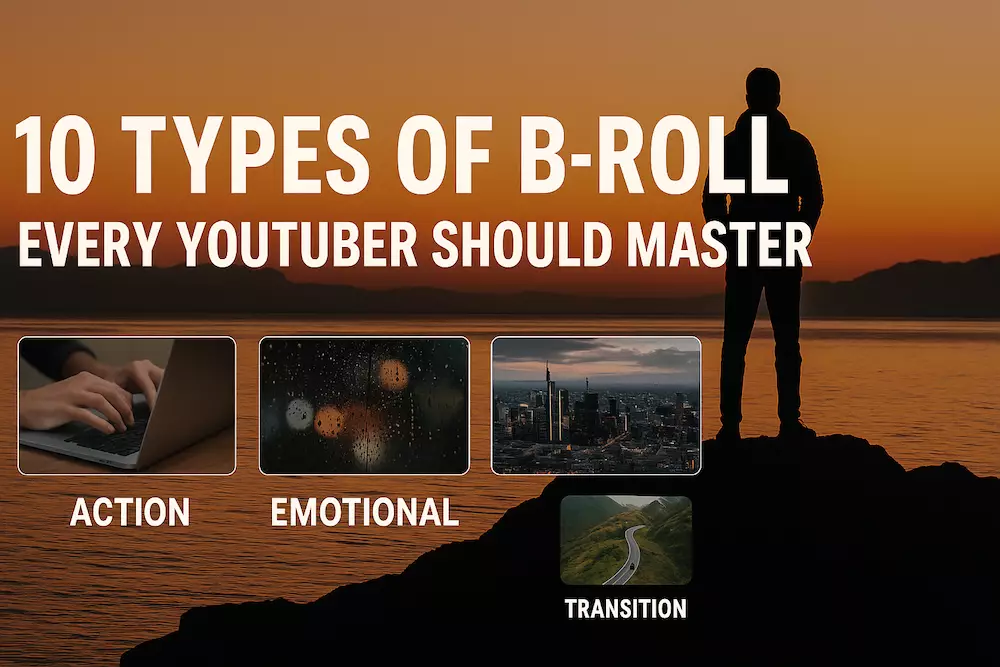
If you’ve ever watched a YouTube video that felt cinematic and emotionally powerful, chances are it wasn’t the A-roll (the part where the person talks) doing the heavy lifting — it was the B-roll.
B-roll refers to the supplementary footage that supports or enhances the main shot. It can include environment scenes, actions, close-ups of objects, or even symbolic visuals like light, water, or shadows that convey a certain mood.
In essence, B-roll gives the audience visual “breathing space” and adds rhythm, emotion, and depth to your storytelling.
Why You Need B-roll
Plain talking-head videos can easily make viewers lose interest. B-roll keeps them engaged and helps your story flow naturally. It can:
- Enhance emotion – Use visuals, lighting, and motion to express feelings more vividly.
- Add clarity – Show the objects or places you’re describing, making your points tangible.
- Improve pacing – Break up static shots with dynamic visuals to maintain attention.
- Elevate professionalism – Even a simple vlog can look cinematic and well-produced with good B-roll.
In short, B-roll is what transforms an ordinary talking video into a compelling visual story. It brings rhythm, depth, and emotion — giving your edits life and movement.
Now, let’s focus on the different types of B-roll and how you can use each one effectively.
Here’s a deep dive into 10 essential types of B-roll, complete with examples and creative use cases.
1️⃣ Action B-Roll — “Show, Don’t Tell”
Purpose: Make your story visible. Turn what you’re describing into visual proof.
Examples:
- Typing on a laptop, scrolling a phone, stirring coffee, or opening a notebook.
- Work scenes: meetings, whiteboard brainstorming, filming behind the scenes, coding.
- Creative moments: painting, playing an instrument, sculpting, editing video.
Best for: Tutorials, productivity vlogs, day-in-the-life, how-to videos.
2️⃣ Emotional / Mood B-Roll — “Feel It Without Words”
Purpose: Build atmosphere through light, motion, and tone.
Examples:
- Loneliness: a single streetlight at night, a shadowed window, raindrops on glass.
- Hope: sunrise, kids running, gentle smiles, leaves glowing in golden light.
- Stress: blue computer glow, traffic jams, messy desks, tapping fingers.
- Peace: calm ocean waves, slow coffee pour, soft morning light.
Best for: Reflective monologues, growth stories, or voice-over essays.
3️⃣ Establishing B-Roll — “Where Are We?”
Purpose: Place the viewer in your world.
Examples:
- City skyline, busy intersections, subway entrances, office exteriors.
- Nature shots: forests, lakes, mountaintops, beaches, or rainy streets.
- Fictional settings: AI-generated medieval cities, futuristic skylines, or ancient temples.
Best for: Travel vlogs, story intros, documentary-style openers.
4️⃣ Time-Transition B-Roll — “Show Time Passing”
Purpose: Indicate a change in time, scene, or chapter.
Examples:
- Timelapse of sunrise/sunset or city lights coming alive.
- Clock hands spinning, shadows stretching, candles burning down.
- Seasonal transitions — falling leaves, first snow, blooming flowers.
Best for: Narrative structure, chapter breaks, emotional transitions.
5️⃣ Informational B-Roll — “Visualize the Abstract”
Purpose: Turn data, facts, or concepts into understandable visuals.
Examples:
- Animated charts, scrolling code, data overlays, or stock footage of servers.
- Science & education: molecules, maps, or close-ups of machinery.
- Tech content: software UI recordings, gadgets, factory assembly clips.
Best for: Explainers, tech videos, finance/education channels.
6️⃣ Metaphorical B-Roll — “Speak Through Symbols”
Purpose: Use visual metaphors to express deeper meaning.
Examples:
- Pressure: flashing red lights, train tunnels, storm clouds.
- Growth: sprouting seed, rising sun, a child’s footsteps.
- Change: turning book pages, breaking chains, butterfly emerging.
- Isolation: a single chair under a lamp, empty streets.
Best for: Thought-provoking, poetic, or philosophical storytelling.
7️⃣ Character Context B-Roll — “Who Is This Person?”
Purpose: Build emotional connection through lifestyle details.
Examples:
- The creator preparing a set, turning on lights, adjusting the mic.
- Interactions: laughter with friends, helping family, walking a pet.
- Work scenes: phone calls, typing, gazing out the window.
Best for: Interviews, creator stories, or docu-style profiles.
8️⃣ Environmental Detail B-Roll — “Let the Space Speak”
Purpose: Make viewers feel the texture of your environment.
Examples:
- Coffee steam rising, shoes hitting pavement, door handle turning.
- Reflections on glass, fingers flipping pages, pen tapping rhythmically.
Best for: Lifestyle, cozy vlogs, ASMR-inspired edits, cinematic B-roll reels.
9️⃣ Transition / Rhythm B-Roll — “Flow Between Ideas”
Purpose: Smoothly bridge scenes or energize the pacing.
Examples:
- Drone fly-overs, whip pans, crash zooms, motion blur transitions.
- Dynamic drone or AI-generated aerial sweeps to reset viewer attention.
Best for: Travel vlogs, tech reviews, fast-paced storytelling.
🔟 Narrative / Flashback B-Roll — “Memory and Meaning”
Purpose: Enrich storytelling or recreate past events.
Examples:
- Vintage photos, sepia tone filters, flickering old film look.
- Archival footage, newspaper clippings, empty playgrounds, childhood toys.
Best for: History, biography, personal journey content.
⚙️ Bonus: AI-Generated Cinematic B-Roll — “Beyond Reality”
Purpose: Express what can’t be filmed.
Examples:
- A human figure dissolving into data streams (“AI awakening”).
- Floating islands, glowing books, time-frozen crowds.
- Surreal visualizations of dreams, thoughts, or digital worlds.
Best for: Sci-fi, psychology, or conceptual storytelling.
🎯 Final Thoughts
B-roll is not “filler.” It’s the visual grammar of storytelling.
A good YouTube video can live without fancy effects — but never without rhythm, emotion, and context.
Think of every B-roll clip as a sentence in your visual language: it should say something, even if no one is talking.