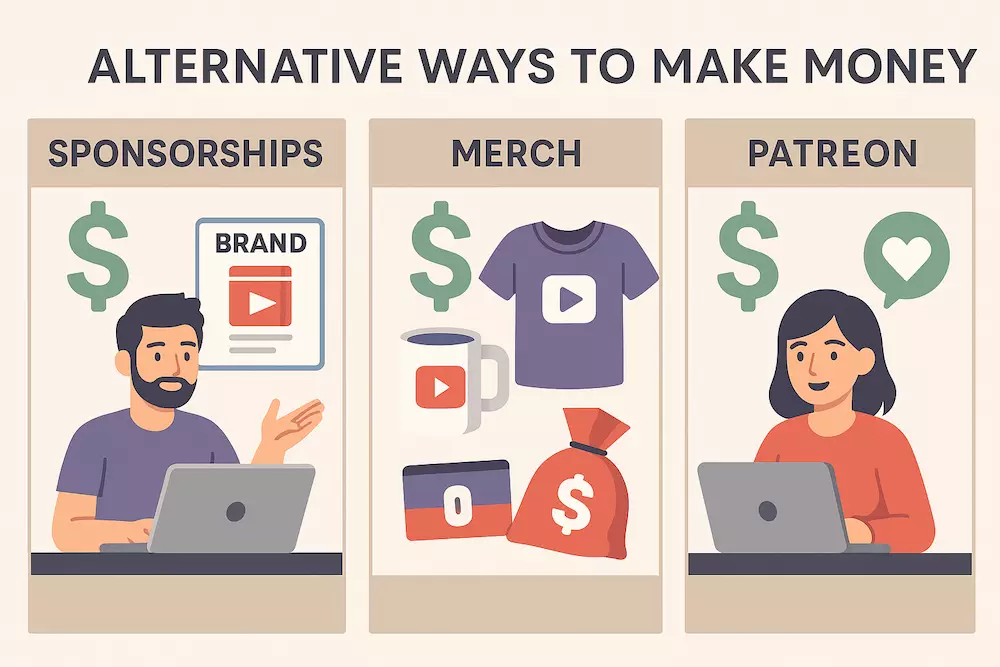
You can make money from a YouTube channel before ad revenue becomes meaningful—and, in many cases, before you qualify for the YouTube Partner Program. The right starting model is not the one with the highest theoretical upside. It is the one that matches a real audience problem, a purchase decision you can influence, and work you can deliver reliably.
For most small creators, the first useful question is not “How many subscribers do I need?” It is “What does this audience already spend time or money trying to solve?”
If you are still comparing ads with these alternatives, start with the YouTube Monetization Guide. It organizes YPP, non-ad revenue and Analytics into one stage-based learning path.
Six ways to make money beyond YouTube ads
| Revenue model | Best fit | Main constraint | Smallest useful test |
|---|---|---|---|
| Sponsorships | A clearly defined audience that a relevant brand wants to reach | Audience fit, brand safety, deliverables and usage rights | Build one sponsor package around a repeatable series |
| Affiliate recommendations | Videos that help viewers compare, choose or use products | Trust, buyer intent and clear disclosure | Add one genuinely relevant product to one high-intent video |
| Services or coaching | A small audience with a valuable problem and evidence of your expertise | Your time and the need to define a concrete outcome | Offer a limited number of structured sessions or projects |
| Digital products | A repeated problem that can be solved with a template, course, tool or guide | Validation, support, updates and refunds | Pre-validate the problem before building the full product |
| Memberships | Returning viewers who want ongoing access, community or recurring help | A continuing promise and a sustainable delivery cadence | Test one repeatable monthly benefit with a small founding group |
| Physical products or merchandise | A strong identity, community signal or product closely tied to the channel | Margins, inventory, shipping, returns and customer support | Use a preorder or limited run to test real demand |
These models are not interchangeable. A tutorial channel may have modest view counts but strong affiliate or service intent. An entertainment channel may have a loyal audience but little reason to buy a problem-solving course. A large audience does not automatically compensate for a weak offer-channel fit.
Use this five-part monetization scorecard
Score a proposed revenue model from 0 to 2 on each question. The score is not a forecast; it forces you to identify what you know and what still needs evidence.
- Problem fit: Does the offer solve a problem viewers repeatedly reveal in comments, searches, emails or watch behavior?
- Purchase intent: Are viewers trying to choose, buy, hire or improve something—or are they only seeking entertainment?
- Credibility: Can you show direct experience, a useful process, a result, or a trustworthy evaluation?
- Operational fit: Can you deliver the promise without making the channel unsustainable?
- Concentration risk: Would one sponsor, platform, product or launch control most of the revenue?
A low score does not mean the model can never work. It means the next action should be research or a small validation test, not a large build.
What to try at each channel stage
Before meaningful traffic or YPP eligibility
Use the channel to learn the audience’s language and problems. A narrowly defined service can work with a small audience because it needs only a few well-matched clients, but it still requires real expertise and a clear scope. Affiliate links can be appropriate when a video genuinely helps a viewer make a product decision. Do not turn every early video into a sales pitch.
When a topic or series attracts consistent viewers
Package the audience and repeatable content format for relevant sponsors. Test a simple digital resource against a problem that appears across multiple videos. Measure whether the monetized video still satisfies the viewer; short-term revenue is not useful if it damages return behavior or trust.
When viewers return for your process or perspective
A membership, product suite or recurring sponsorship may become viable because the audience understands what it will receive. This is also the stage to reduce concentration risk: avoid allowing one brand, launch or platform feature to become the entire business.
How to approach sponsorships
There is no universal sponsor rate based only on subscribers or views. A useful quote starts with the specific deliverable and its business terms:
- the integration type, placement and approximate duration;
- the expected audience and why the product fits that audience;
- production time, revision rounds and approval deadlines;
- whether the brand can reuse the content in its own ads or channels;
- category exclusivity and how long it lasts;
- payment timing, cancellation terms and required reporting.
Usage rights and exclusivity are separate value and risk, not free additions to an integration. Put the scope in writing. Before pitching, create one short sponsor page with the channel promise, audience, representative videos, relevant performance evidence and one or two deliverable options. Do not inflate forecasts or hide weak fit behind a subscriber count.
How to use affiliate links without losing trust
Affiliate monetization works best when the content already serves a decision: a comparison, setup, tutorial, workflow or honest review. Recommend products you can evaluate, state important limitations, and keep the recommendation useful even if the viewer does not buy.
A commission or free product is a material relationship. The U.S. Federal Trade Commission says disclosures should be hard to miss and placed with the endorsement; for video, the disclosure should be in the video rather than only in the description. Use plain language your audience understands. YouTube also requires creators to notify the platform when a video contains paid promotion. Requirements vary by country and situation, so check the current FTC disclosure guidance, YouTube paid-promotion guidance, and the rules that apply to you. This is practical editorial guidance, not legal advice.
Validate products and memberships before building them
Do not begin with months of production. Start with evidence:
- Collect recurring questions from comments, email, community posts and conversations.
- Describe one audience, one problem and one promised result in a sentence.
- Test the solution manually with a small number of people.
- Ask for a real commitment—a preorder, paid pilot or founding membership—not only a poll response.
- Record what required support, what people misunderstood and what outcome they actually valued.
- Build only the repeatable parts that survived the test.
Memberships require an ongoing reason to stay. “Support the channel” may work for a deeply loyal audience, but most programs are stronger when the recurring benefit is concrete and sustainable. A physical product adds fulfillment, returns and margin risk; do not treat revenue as profit.
Measure the business model, not just gross revenue
Track each model separately. A simple monthly review can include:
- revenue, direct costs, refunds and fees;
- creator and team hours required to sell and deliver;
- qualified inquiries, conversions or attributed sales;
- revenue concentration by sponsor, product and platform;
- whether sponsored or sales-oriented videos changed viewer satisfaction and return behavior.
Use tagged links or campaign codes when appropriate, but do not pretend attribution is perfect. Compare business evidence with the audience and content evidence explained in the YouTube Analytics Guide. A model that produces revenue but consumes all production time may prevent the content engine that created the demand.
A practical 30-day monetization test
- Week 1: Choose one recurring audience problem and score two possible models.
- Week 2: Speak with viewers or customers and define the smallest real offer.
- Week 3: Publish one useful, closely related video and make the offer transparently.
- Week 4: Review response, delivery cost, audience reaction and what you learned. Continue, revise or stop the test.
Test one primary model at a time. “Diversification” does not mean launching sponsorships, a store, a membership and a course in the same month. It means building a second reliable source after the first one has evidence and a manageable process.
Frequently asked questions
Can you make money on YouTube without being in YPP?
Yes. Sponsorships, affiliate commissions, services, products and external memberships do not depend on YPP enrollment, although each platform, payment method and jurisdiction can have its own eligibility and disclosure rules.
Which monetization method is best for a small YouTube channel?
There is no universal winner. A service may fit a small expert audience; affiliate links may fit high-intent product content; a membership may require strong return behavior. Choose based on audience problem, purchase intent, credibility and delivery cost rather than subscriber count alone.
How many subscribers do I need for sponsorships?
There is no platform-wide subscriber requirement for a direct brand sponsorship. Brands evaluate audience fit, expected performance, content quality, safety and commercial terms. A small, specific audience can be more relevant than a larger, poorly matched one.
Should I start with merchandise?
Only if viewers already identify strongly with the channel or the product itself solves a channel-specific need. Generic logo merchandise often has weak demand, while shipping, returns and customer support remain real costs.
Should I join YPP or build other income first?
They are not mutually exclusive. If your channel is eligible, use the YouTube Partner Program application guide. At the same time, evaluate whether a different model better matches the audience. YPP is a platform earning system; it is not the whole creator business.