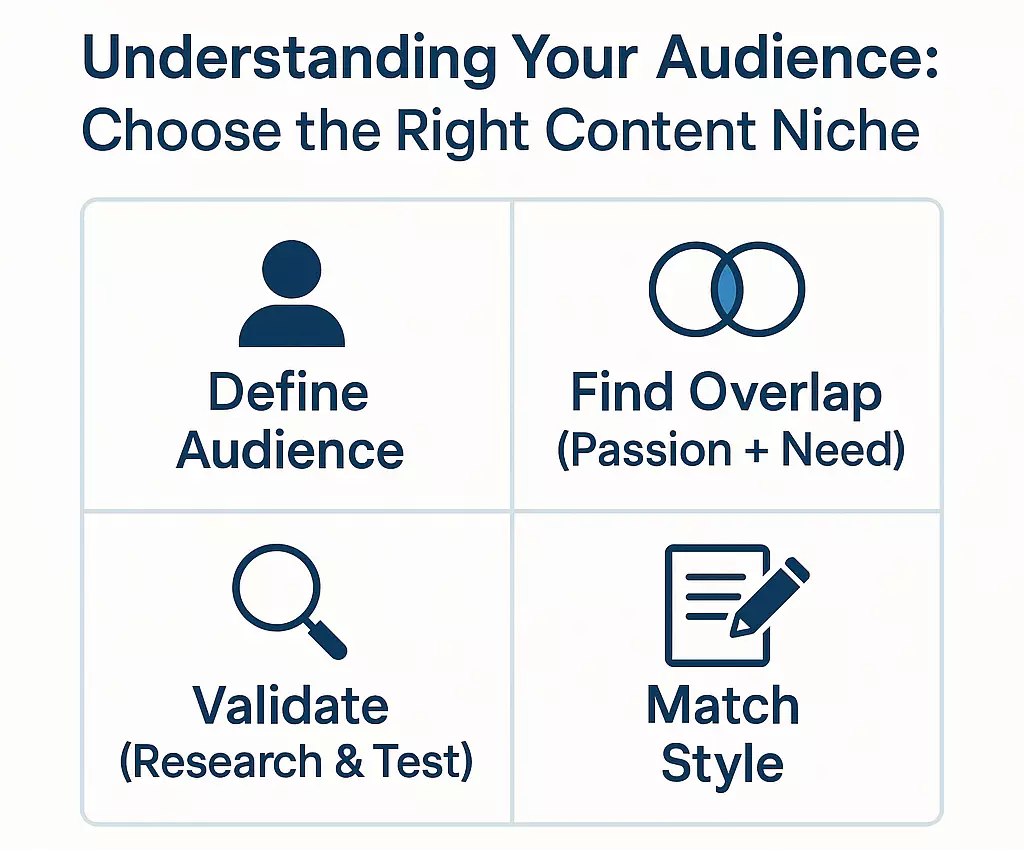
A useful YouTube niche is not simply a popular topic. It is a repeatable promise for a recognizable viewer: the kind of person you help or entertain, the subject you return to, and the reason they should choose your version.
The goal is not to predict the perfect niche before publishing. The goal is to choose a focused starting hypothesis, validate that you can produce it and that viewers respond, then narrow or expand with evidence.
What “niche” means on YouTube
A category such as fitness, gaming, cooking, or personal finance is usually too broad to guide individual videos. A niche becomes more useful when it combines:
- Viewer: who repeatedly cares about the content.
- Problem or desire: what they want to solve, learn, feel, or experience.
- Subject: the area in which you can make many related videos.
- Format or perspective: how your version is recognizably different.
“Photography” is a category. “Simple phone photography lessons for parents who want better family photos” is a usable starting niche because it suggests a viewer, result, constraint, and many possible videos.
Step 1: Define one starting viewer
Do not begin with demographics alone. Age and location may matter, but they rarely tell you what video to make. Describe the viewer’s situation.
Complete these prompts:
- They are currently trying to ______.
- They already know or have ______.
- They are frustrated by ______.
- They would consider a video useful if it helped them ______.
- They prefer this content because my perspective offers ______.
Use one person as the starting point, not the permanent limit of the channel. If several groups eventually respond to the same promise, the audience can broaden naturally.
Step 2: Find your durable contribution
Interest matters because channels require repeated work, but “follow your passion” is not enough. Look for a subject where at least two of these are true:
- You have direct experience, training, access, or a useful learning journey.
- You can explain the subject with a perspective viewers do not get from generic summaries.
- You are willing to research and make at least 20 related videos.
- The production process fits your time, privacy, budget, and skills.
- You can show examples, tests, demonstrations, stories, or results.
You do not need to be the world’s leading expert. You do need to be honest about what you know, what you tested, and what remains uncertain.
Step 3: Build a 20-idea test
Before naming the channel around one narrow concept, write 20 plausible video ideas. Divide them into four groups:
- Beginner questions: what does a new viewer need first?
- Specific problems: what repeatedly goes wrong?
- Comparisons or decisions: what choices require help?
- Evidence and stories: what can you test, document, or analyze?
A niche that produces only three variations of the same idea may be too narrow. A list in which every idea serves a different person may be too broad.
Step 4: Check real audience language
Research is not copying the most-viewed channels. Look for the exact language viewers use and the gaps between their question and the available answers.
- Type the problem into YouTube search and note autocomplete phrasing.
- Study recent and evergreen results: titles, formats, depth, and who they appear to serve.
- Read comments for follow-up questions, confusion, and constraints.
- Look in communities where the viewer already discusses the problem.
- Check whether smaller channels or individual videos can still attract meaningful attention.
Do not treat a keyword tool’s number as proof that your exact video will succeed. Demand, competition, packaging, viewer satisfaction, and your ability to produce all matter. For a deeper topic process, use How to Find YouTube Topics With Demand and Lower Competition.
Step 5: Write a niche hypothesis
Turn the research into one sentence:
I make [type of videos] for [specific viewer] who wants [result or experience], using [perspective, proof, or format].
Example:
I make short, evidence-based YouTube experiments for small educational creators who want consistent search traffic without publishing every day.
This is a working editorial constraint. It should help you reject unrelated ideas, but it is not a lifetime contract.
Step 6: Validate with three pilot videos
Choose three related ideas that test different parts of the hypothesis:
- One clear beginner or search question.
- One specific problem or mistake.
- One example, experiment, comparison, or story.
Keep the viewer and basic production format similar enough that the results are comparable. Before publishing, write down what each video is testing: topic demand, title promise, format, depth, or your ability to produce it sustainably.
After publishing, review more than views. Check how viewers found the video, whether the title and thumbnail earned clicks in context, where retention changed, what questions appeared, and how difficult the video was to make. The beginner YouTube Analytics guide explains the reports.
How to decide after the pilot
| What you observe | Possible decision |
|---|---|
| Viewers respond to one problem but ignore the others | Narrow the next batch around that problem. |
| People click but leave early | Improve the opening and delivery before abandoning the niche. |
| Useful comments arrive but production is unsustainable | Simplify the format or reduce frequency. |
| The ideas attract unrelated audiences | Clarify the viewer promise and separate incompatible topics. |
| You cannot produce 20 credible ideas | Broaden the problem, viewer, or format one level. |
Common niche-selection mistakes
- Choosing only by reported CPM or profitability. A valuable market does not help if you cannot earn attention or trust.
- Copying a large creator’s category. Their audience, access, history, and production system are different.
- Making the niche so broad that every upload serves a new viewer.
- Making it so narrow that the channel depends on one phrase or trend.
- Changing direction after every low-view video. Diagnose topic, packaging, and delivery separately.
- Using “the algorithm” as the audience. YouTube distributes videos to people; your promise must make sense to them.
A niche is a starting system, not a label
The best early niche is specific enough to guide your next videos and broad enough to survive learning. Define a viewer, create a repeatable promise, test several related ideas, and revise with evidence.
When the hypothesis is clear, choose a flexible channel name and handle, then use the Start a YouTube Channel guide to complete the launch.