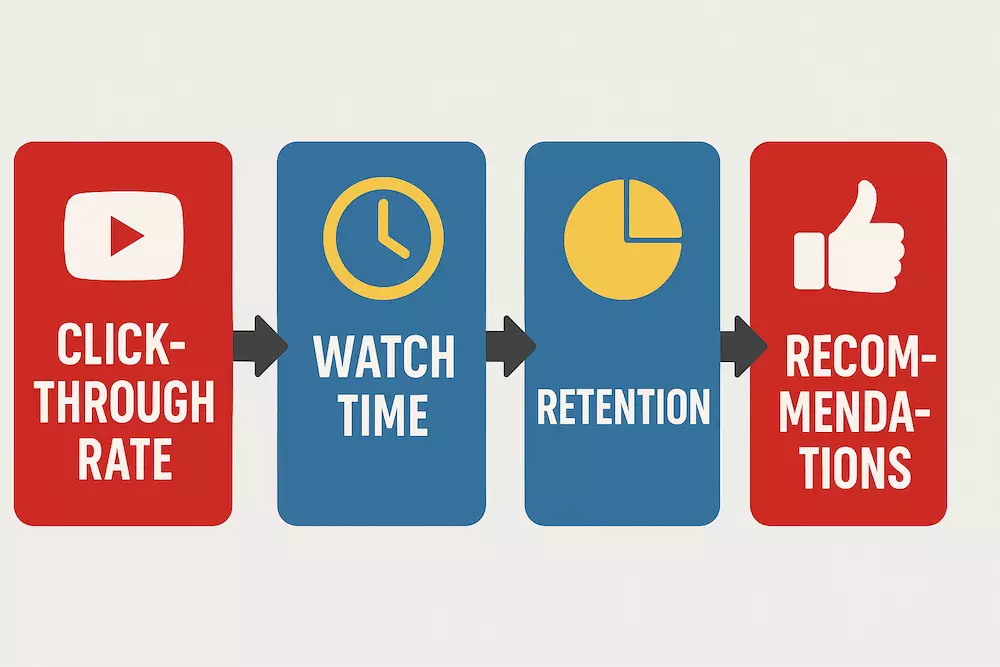
YouTube does not use one universal “algorithm” that gives every viewer the same ranked list. Its recommendation and discovery systems personalize different surfaces, evaluate how people respond when content is offered, and account for external conditions such as topic interest, competition and seasonality.
The practical conclusion is not “maximize watch time at any cost.” It is to make a relevant promise to an identifiable audience, help the right viewers choose it, satisfy the expectation, and learn from comparable evidence.
Documentation reviewed August 17, 2026 (site time). This page is an editorial synthesis of YouTube’s public creator documentation, not a reverse-engineering experiment or a claim to know private ranking weights.
Research question
What does YouTube currently tell creators about how videos are selected and recommended, which explanations are supported by the official documentation, and which common creator claims go beyond the available evidence?
Method
- Reviewed current YouTube Help pages that directly describe recommendations, content performance, external factors, surface-specific behavior, upload frequency and creator Analytics.
- Included only first-party YouTube documentation in the findings table below.
- Separated YouTube’s stated system behavior from Tinyfool’s practical interpretation.
- Rejected universal thresholds, private signal weights and causal claims that the sources do not provide.
- Recorded limitations and interface-dependent details so the review can be repeated after major documentation changes.
This method can explain the public model and improve diagnosis. It cannot prove the exact reason a particular video was or was not recommended.
Finding 1: recommendations are personalized
YouTube says its recommendation system aims to help each viewer find videos they want to watch and maximize long-term viewer satisfaction. Personalization uses evidence such as watch and search history, subscriptions, likes, dislikes, “not interested” feedback and satisfaction surveys.
That means a video does not have one fixed recommendation position. It can be a strong candidate for one viewer and irrelevant to another based on their interests, history, language, format preference, device and context.
Finding 2: creator-facing performance evidence has three buckets
YouTube’s content-performance documentation groups the relevant creator questions into three buckets:
| Bucket | Question | Observable creator evidence |
|---|---|---|
| Appeal | Did people choose the content or ignore it? | Topic framing, title, thumbnail, impressions, CTR and “not interested” behavior in context |
| Engagement | After choosing it, did viewers continue watching? | Watch time, average view duration, average percentage viewed and retention moments |
| Satisfaction | Did viewers enjoy or value the experience? | Likes, shares, surveys and other positive or negative feedback described by YouTube |
These are diagnostic categories, not a formula. YouTube does not publish a universal CTR, retention percentage or engagement total that guarantees distribution.
Finding 3: each surface uses different context
| Surface | Important context stated by YouTube | Creator implication |
|---|---|---|
| Home | Primarily personalized from the viewer’s watch history and other preference evidence | A broad keyword match is not enough; the video must be a plausible choice for that viewer |
| Up Next | The video currently being watched is a major signal, with personalization also involved | Related series and a genuinely useful next watch can make the channel easier to continue |
| Search | Relevance, engagement and quality; query match includes title, description and video content | Answer a recognizable task and satisfy the search, rather than repeating keywords |
| Shorts Feed | Personalized format-specific viewing behavior and content response | Do not assume every Shorts viewer has the same long-form preference |
| Subscriptions | Recent uploads from channels the viewer subscribed to | A subscription creates access, not a guarantee that each upload will be chosen |
Because surfaces differ, a channel-wide average can hide the real result. Read CTR, retention and viewer behavior by traffic source and comparable format where possible.
Finding 4: opportunity changes outside the video
YouTube names three external factors that influence how many people see a video:
- Topic interest: some topics have larger or changing audiences.
- Competition: a video competes with all other content that viewer might want at that moment, not only with the creator’s previous uploads.
- Seasonality: audience activity and interests change through the year.
This explains why “my metrics look similar to the last video” is not enough to predict equal impressions. The available audience and competing choices may be different.
Finding 5: several common algorithm claims are not supported
| Claim | What the official documentation supports | Verdict |
|---|---|---|
| “You must upload daily or weekly to keep the algorithm active.” | YouTube says it has not found growth in views to be correlated with time between uploads and recommends quality over quantity. | Not supported |
| “Taking a break permanently hurts the channel.” | YouTube says it found no correlation between break length and changes in views, while noting that an audience may need time to return to routine. | Not supported as a universal penalty |
| “Publish time determines long-term performance.” | Publish time can affect early viewing, live streams and Premieres, but YouTube says it is not known to affect long-term video performance. | Not supported for ordinary long-term performance |
| “Trying Shorts will confuse a long-form channel’s algorithm.” | YouTube says experimenting across formats does not inherently confuse the system; viewers can still have different format preferences. | Not supported as an automatic penalty |
| “A monetized video is recommended more.” | YouTube says its recommendation system does not prioritize a video because monetization is enabled. | Not supported |
| “A high CTR proves the thumbnail is good.” | CTR varies by surface and audience and can fall while impressions and views expand. | Incomplete without context |
| “One failed experiment damages the whole channel.” | YouTube says an individual video’s underperformance does not automatically penalize the channel; repeated viewer disinterest can affect future response. | Not supported as a one-video penalty |
What this means for a small channel
- Define the audience opportunity. Who needs the video and what other choices compete for that attention?
- Make one clear promise. The title and thumbnail should help the intended viewer recognize the value.
- Deliver the promise. Use retention to find moments to investigate, not to chase a universal percentage.
- Create the next useful watch. A related library makes it easier for a satisfied new viewer to continue.
- Compare like with like. Separate Shorts from long-form, search from Home, and fresh uploads from mature evergreen videos.
- Run controlled experiments. Change one main variable across a small group of comparable videos and record the result.
The Get Consistent Views Guide turns these findings into a four-stage diagnosis and three-video experiment. The YouTube Analytics Guide explains how to read the related reports without treating one metric as the whole story.
A practical evidence matrix
| Observation | Possible explanation | What would strengthen the diagnosis? |
|---|---|---|
| Low impressions across several related videos | Limited topic interest, strong competition or unclear audience match | Result-page review, topic trend, comparable channel evidence and a sharper audience brief |
| Impressions expand and CTR declines while views rise | The system may be testing a broader audience | Traffic-source mix, retention and satisfaction evidence from the broader distribution |
| Strong CTR and weak opening retention | The delivered opening may not match the clicked expectation | Direct comparison of title-thumbnail promise with the first proof or payoff |
| Strong retention and limited discovery | The viewers who choose it are satisfied, but the opportunity or packaging may be narrow | Traffic source, topic demand, result gaps and packaging clarity |
| A successful video does not grow the rest of the channel | The topic may be isolated or lack a relevant next watch | Follow-on viewing, end screens, series structure and audience overlap |
Each explanation above is a hypothesis. Analytics can show where behavior changed; it rarely reveals a single private ranking cause.
Limitations
- YouTube’s public documentation describes system goals and creator-facing signals but does not publish complete models, weights or thresholds.
- Recommendation systems and Studio reports change over time; interface names can differ during rollouts.
- Official documentation is the platform’s explanation of its own systems. This review does not independently audit the production models.
- No third-party channel dataset or controlled upload experiment is used here, so this page does not estimate causal effect sizes.
- Individual channel results depend on audience, topic, format, competition and execution; no finding guarantees distribution.
Frequently asked questions
What is the most important YouTube ranking factor?
YouTube does not publish one universal factor. Its documentation describes personalization plus appeal, engagement, satisfaction and external context. The relevant mix also differs by surface and viewer.
Does watch time matter?
Yes, watch behavior is useful engagement evidence, but “maximize watch time” is not a complete description of long-term viewer satisfaction or personalized recommendations. Average view duration and percentage viewed should be interpreted with format, length and traffic source.
Does CTR affect recommendations?
Viewer choice is part of appeal, but CTR is not a standalone pass/fail score. It changes with where the impression appeared and which audience received it.
Will uploading more often increase views?
Not automatically. YouTube says it has not found view growth to be correlated with the time between uploads. Use the Content System Guide to choose a sustainable cadence that protects the audience promise.
Can a small channel be recommended?
Yes. YouTube’s documentation does not describe subscriber count as a requirement for recommendations. A small channel still needs a relevant audience opportunity and content viewers choose and enjoy.
Official sources reviewed
- YouTube’s Recommendation System
- Understand your content performance
- Understand external recommendation factors
- Good to know about recommendations
- How YouTube recommendations work
- YouTube performance FAQ and troubleshooting
- Decode impressions and click-through rate
- Measure key moments for audience retention