Executive summary
- The clearest pattern was not “chase a broader topic.” In 20 of the 22 channels with a qualifying breakout, the strongest video stayed within the channel’s core subject. The other two moved only into a closely related use case.
- The strongest titles made the value unusually concrete. Every one of the 22 titles named a specific tool, object or subject; 18 promised a clear outcome. Tutorials and result-driven videos were the largest group, but comparisons, timely updates and surprising explanations also worked.
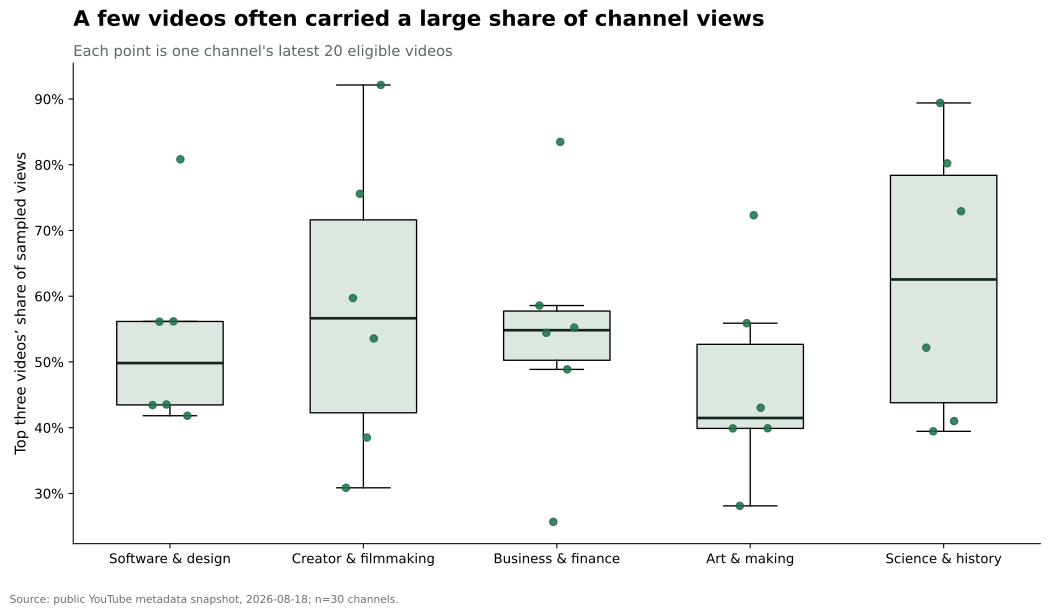
- These outliers mattered because views were highly concentrated. Across all 30 channels, the median channel received 54.0% of its sampled views from just three videos. For a small channel, learning from the right outlier can matter more than improving the average upload.
The practical conclusion is simple: a small YouTube channel is more likely to find a breakout by sharpening its existing promise than by borrowing an unrelated viral topic. The opportunity is usually a more specific result, a more important decision, a clearer constraint or a timely new problem for the audience the channel already serves.
Public-data snapshot: August 18, 2026. This study covers 600 mature long-form videos from 30 English educational channels with 1,000–49,999 current public subscribers. It describes patterns in public metadata; it does not prove that a title, thumbnail or topic caused a video to break out.
How this study defines a breakout
A fixed view threshold would make little sense here. A video with 20,000 views means something very different on a 2,000-subscriber channel than it does on a 47,000-subscriber channel. Older videos have also had more time to accumulate views than newer ones.
For that reason, each video was compared only with the other 19 videos in the same channel sample. It had to pass two tests:
- Lifetime performance: at least five times the channel sample’s median lifetime views.
- Performance over time: at least five times the channel sample’s median views per day.
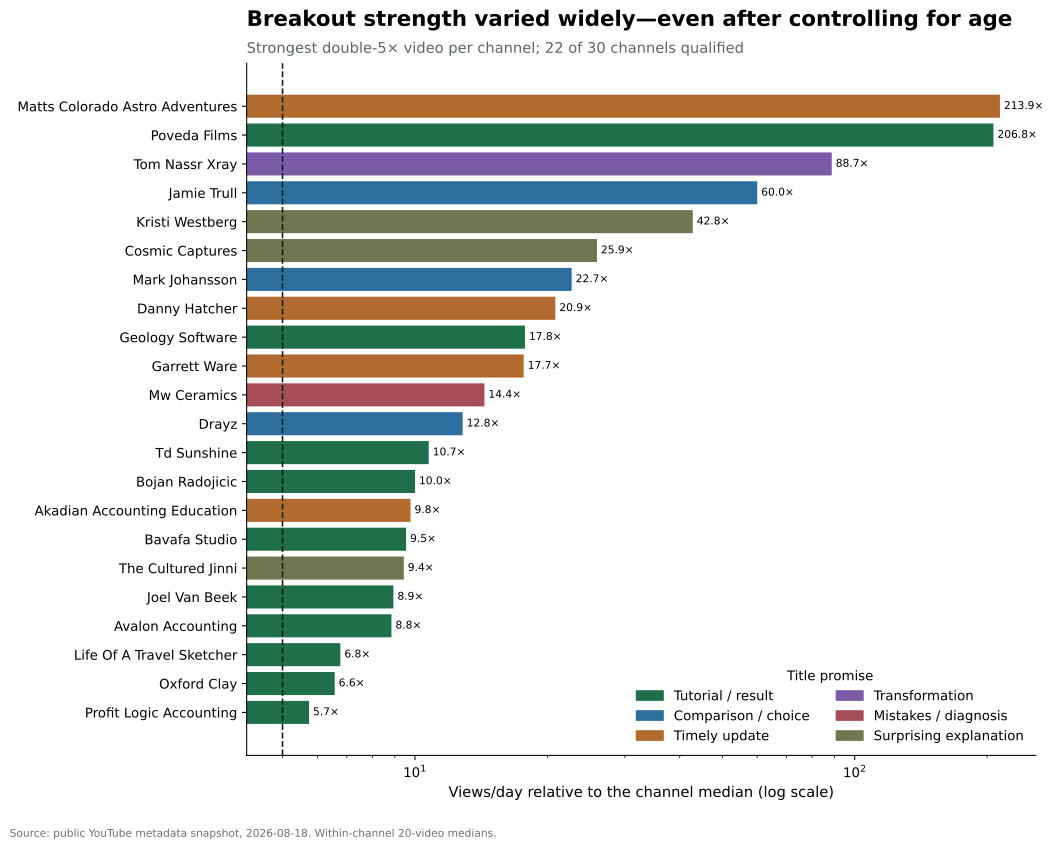
Requiring both tests filters out two misleading cases: an old video that looks large only because it has had years to grow, and a very recent spike that has not yet accumulated enough evidence. Under this rule, 43 of the 600 videos qualified as breakouts, spread across 22 of the 30 channels.
To compare titles without allowing one unusually successful channel to dominate the analysis, I then kept only the strongest qualifying video from each channel. That left 22 titles. Across those channels, the median top breakout had 13.6 times the views per day of its own channel baseline.
A few videos carried a large share of the audience
Breakout videos were not just statistical curiosities. They accounted for a substantial share of the attention in each channel’s sample. Across all 30 channels, the median top video produced 26.2% of sampled views, while the median top three produced 54.0%.
That does not mean every seventh upload should go viral, or that a creator can schedule an outlier on demand. It means the average upload can hide the videos that revealed the most about audience demand, packaging and topic fit. For a small channel, those outliers deserve a deliberate follow-up rather than a quick celebration followed by a return to business as usual.
The winning idea usually strengthened the existing channel promise
The most important result was where the breakout ideas came from. Twenty of the 22 strongest breakout videos were core to the channel’s established subject. The remaining two were adjacent rather than unrelated: a design channel covering a current AI integration, and a financial-modeling channel using AI to complete the same familiar task faster.
None of the 22 channels needed a wholesale niche change. What changed was the size or clarity of the promise. A familiar audience was offered a more complete result, a higher-stakes decision, a sharper constraint, a more visible example or a new reason to act now.
The better question is not “What unrelated topic is hot?” It is “What larger, clearer or more urgent promise can I make to the audience I already chose?”
Practical promises were the most common
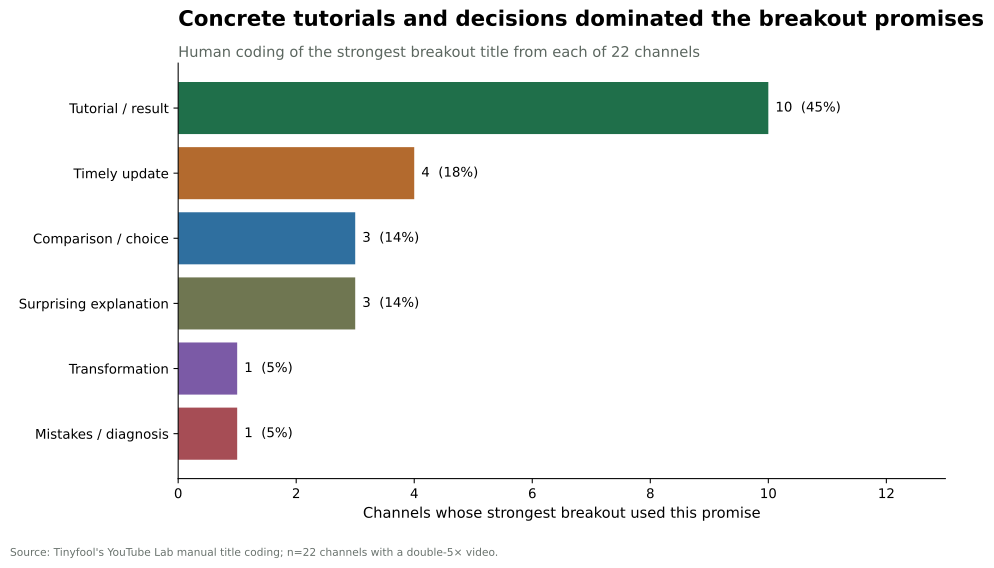
Ten of the 22 strongest breakout titles promised a tutorial or a concrete result. They did more than name a broad subject. They offered a finished task: connect Claude to Figma, complete payroll for Canadian employers, build a financial model faster, make an ash glaze or interpret XRD data step by step.
Three others helped the viewer compare or choose. Together, tutorial/result and comparison/choice promises appeared in 13 of 22 cases (59%). But this was not a single winning template. Four timely updates, three surprising explanations, one transformation and one diagnosis also qualified. The common thread was a clear job for the video, not a particular title formula.
Specificity mattered more than manufactured mystery
Every one of the 22 titles named a recognizable tool, object or subject. Eighteen stated an outcome, and 15 made the intended audience or a meaningful constraint visible. Only five relied on a clear curiosity gap.
This distinction is useful because “make it more intriguing” is difficult to act on. Specificity can be inspected before production: Which software? Which viewer? Which result? Under what limitation? What will be different by the end of the video?
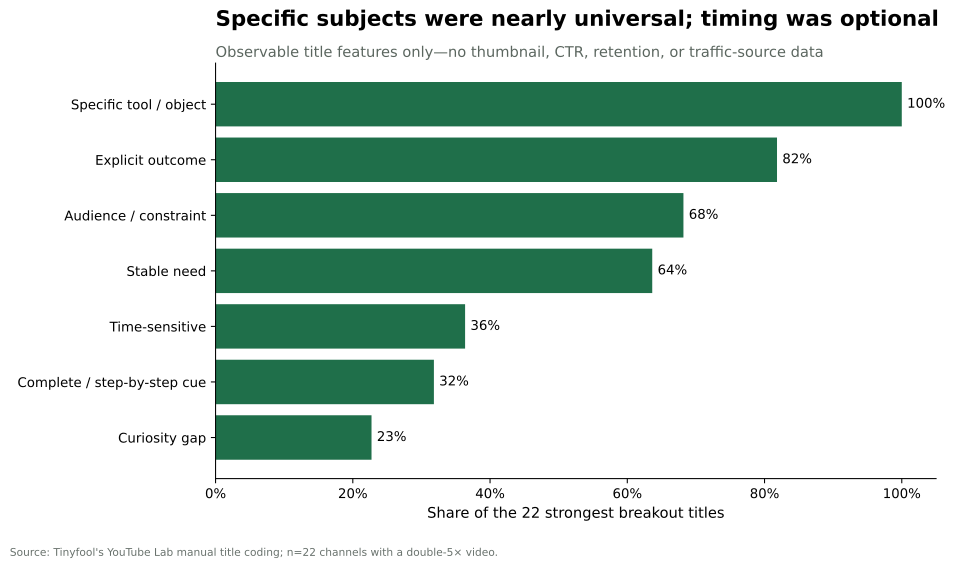
Nor was the word “complete” a magic ingredient. Only seven titles used a completeness or step-by-step cue. A video can make a concrete promise without sounding like a textbook or turning every headline into an “ultimate guide.”
Evergreen and timely ideas played different roles
Fourteen of the 22 strongest breakout titles addressed a stable, recurring need. Eight depended on a year, product update, certification cycle, review window or astronomical event. Both kinds of opportunity appeared in the same overall pattern: they solved a recognizable problem for the channel’s audience.
This suggests a more resilient content library than either extreme:
- Build the base with stable demand. Tutorials, decision guides and recurring audience problems can keep earning attention long after publication.
- Use timely videos selectively. A new tool, rule or event is valuable when it creates a genuine new task for the same audience—not merely because it is trending.
An evergreen video answers “Why will someone still need this?” A timely video answers “Why does this audience need it now?” A strong editorial system has room for both.
Turn the pattern into an editorial filter
Before committing an idea to production, use these five questions to find vague promises early:
- Is the subject specific? Name the tool, object, situation or decision instead of hiding behind a broad category.
- Is the outcome visible? Can the viewer tell what they will make, understand, choose, avoid or improve?
- Is the audience or constraint recognizable? “Beginner,” “Canadian employer,” “wedding videographer,” “small business” and “without replacing your current system” all narrow the job.
- Does it serve the core audience or a credible adjacent need? The idea should expand the channel promise, not attract an audience the next video cannot serve.
- Why now—or why for years? Identify either a durable recurring need or a real time-sensitive trigger.
This is a filter, not a requirement that every idea score five out of five. A beginner guide does not need a trend attached to it, and a product update does not need to pretend it is evergreen. The purpose is to make the promise explicit before the expensive work begins.
Test the pattern on your own channel
The public study can suggest what to test, but your own YouTube Studio data is what tells you why a particular video worked. A useful first cycle is six related videos:
- Choose one audience problem. Keep the six videos close enough in subject and audience that their results remain comparable.
- Develop three concrete-result ideas. Use a tutorial, decision, transformation or diagnosis promise.
- Develop three opportunity ideas. Use either a timely change or a surprising but still core explanation.
- Record each promise before publishing. Save the audience, outcome, constraint and whether the need is stable or timely.
- Review each video at a comparable age. Compare its views per day with the median of your own recent videos, not with another channel’s headline view count.
- Diagnose the mechanism in Studio. Use impressions and traffic sources to understand opportunity, CTR to understand viewer choice, retention to understand delivery, and subscriber or next-video behavior to understand audience fit.
The Get Consistent Views Guide explains the opportunity → choice → delivery → next-watch sequence. The YouTube Analytics Guide shows where to find the evidence without reducing performance to one number.
What the public data still cannot tell us
This study identifies a useful pattern, but not the mechanism behind it. A title may state the promise, while the thumbnail earns the click, the video earns retention and YouTube distribution determines how many people see the package. Public view counts cannot separate those effects.
The next useful research step is therefore not another list of successful titles. It is a matched comparison between breakout and non-breakout videos from the same channels, followed—where creators can provide private Studio data—by a check of impressions, traffic sources, CTR, retention and next-video behavior. That would help answer three questions left open here:
- Are these title signals genuinely more common in breakouts than in ordinary videos from the same channel?
- Do stable and timely breakouts arrive through different traffic sources or grow on different timelines?
- Which outliers bring the right future audience, rather than only a one-time view spike?
Method and sample
- Channel sample: 30 current English creator-led educational channels with 1,000–49,999 public subscribers.
- Balanced categories: six each in software/design, creator/filmmaking, business/finance, art/making and science/history.
- Video sample: the latest 20 eligible videos per channel on August 18, 2026.
- Maturity window: 90–730 days old.
- Format window: 120–3,600 seconds; live, upcoming and archived-live videos excluded.
- Public fields: video title, publication date, duration, view count, channel ID and current rounded subscriber count.
- Breakout threshold: at least five times both the channel median lifetime views and the channel median views per day.
- Cross-channel coding: the strongest qualifying video per channel, with a maximum of one per channel.
The 30-channel sample
| Category | Channels |
|---|---|
| Software & design | Kevin Vandermarliere; Joel Van Beek; TD Sunshine; Danny Hatcher; Tom Nassr | XRAY; Fadel |
| Creator & filmmaking | Oscar Owen Business; Garrett Ware; Mark Johansson; Bruno Pozo; drayz; Poveda Films |
| Business & finance | Avalon Accounting; Bojan Radojicic; Be a PROFITABLE Badass Business Owner; Jamie Trull; Akadian Accounting Education; Profit Logic Accounting |
| Art & making | Life of a Travel Sketcher; Smashing Sketches; MW Ceramics; Kristi Westberg; bavafa studio; Oxford Clay |
| Science & history | The Cultured Jinni; GeologyUpSkill; Matt’s Colorado Astro Adventures; CosmicCaptures; Astronomy Garage with Reflactor; Geology Software |
The analysis notebook checks all 600 video IDs, sample counts, dates, durations, subscriber ranges and calculations before producing the charts. It reproduced every saved metric. In a same-coder consistency check, five of five rechecked titles received the same promise type and the same core/adjacent classification.
Limitations
- The sample was purposefully assembled and is biased toward channels that could be discovered through search. It is not a random estimate of all small YouTube channels.
- Current public subscriber counts are rounded; they are not subscriber counts at the time each video was published.
- View counts continue to change after the snapshot.
- Public data cannot show impressions, CTR, audience retention, traffic source, watch time, subscriber conversion or revenue.
- The title coding describes features among breakouts. Without a manually coded matched control group, these percentages are not estimates of uplift.
- Six channels per category preserve content variety but are not enough to say that one category is easier than another.
- The evidence shows association and concentration. It does not show that any title feature caused the view result.
Frequently asked questions
Does a small YouTube channel need a viral topic?
Not an unrelated one. In this sample, 20 of 22 strongest breakout videos stayed inside the channel’s core topic and two used an adjacent method. The opportunity was usually a stronger promise to the existing audience.
Should every breakout idea be a tutorial?
No. Tutorials and concrete results were the largest group, but timely updates, comparisons, surprising explanations, transformation and diagnosis also appeared. Choose the promise that fits the viewer’s task.
Are evergreen videos better than trends?
The evidence supports a mix, not a winner. Fourteen strongest breakouts addressed a stable need and eight were time-sensitive. A sustainable channel can build an evergreen base and respond selectively when a current change matters to the same audience.
Can I use the 5× rule in YouTube Studio?
Yes, as an internal outlier screen. Compare a mature video’s views and views per day with a consistent sample of recent videos from your own channel. The rule is an editorial tool, not a YouTube ranking threshold.
Does this prove specific titles get more views?
No. Specificity was common among the strongest breakouts, but this study cannot isolate the title from topic demand, thumbnail, delivery, audience fit or distribution. Use the pattern to design better experiments, not to promise a result.
Sources and reproducibility
- YouTube Data API overview
- YouTube Channels resource documentation
- YouTube Videos resource documentation
Research record: the frozen channel list, raw public snapshots, selection and exclusion logs, title codebook, executed notebook, calculation spot checks and chart outputs are versioned with this site. The study can be rerun as a new dated snapshot; it should not silently overwrite this one.