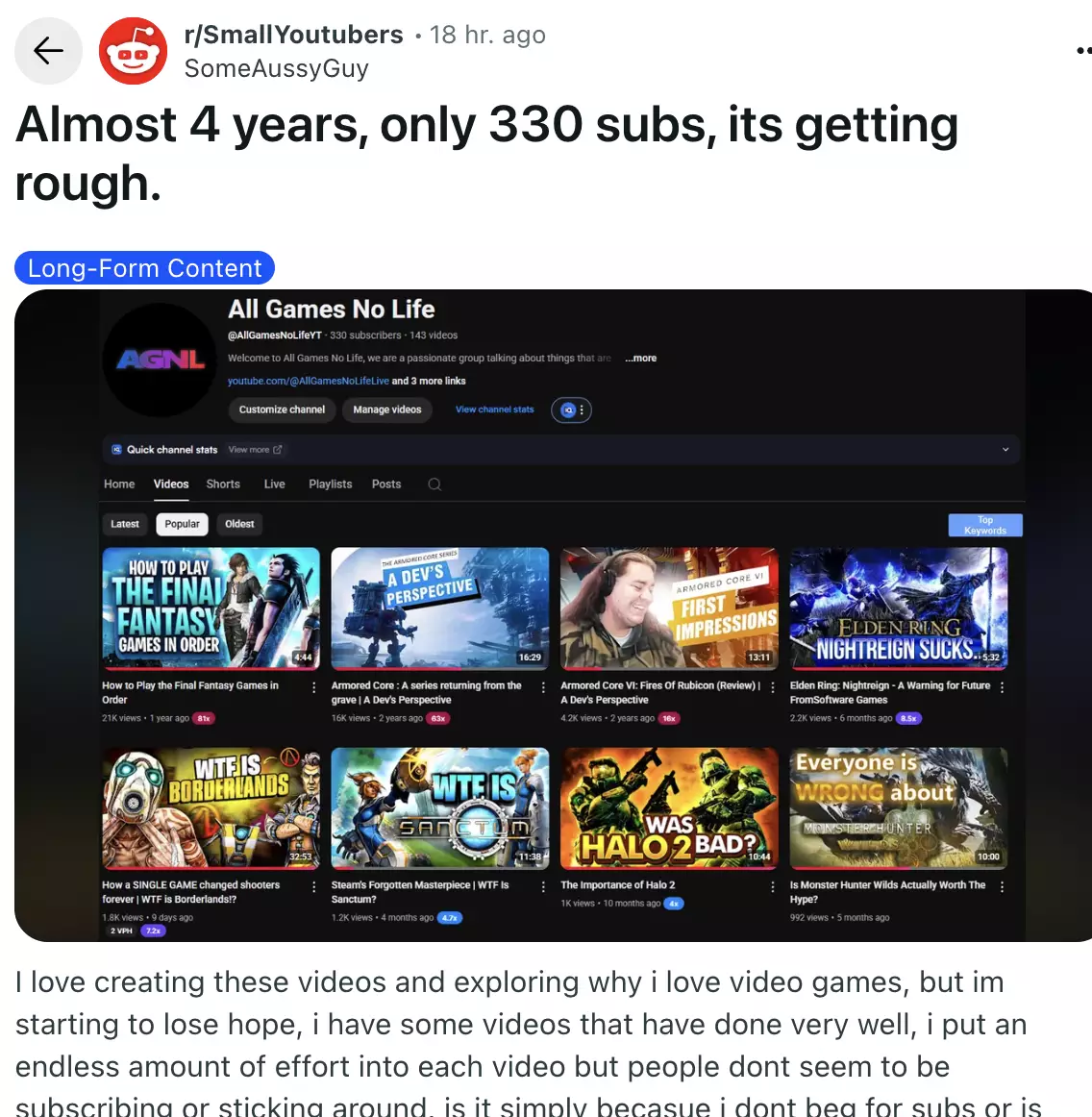
A creator in r/SmallYoutubers posted a question that many small channels eventually ask: after years of work, why does the subscriber count still feel stuck?
The creator, who runs All Games No Life, makes long-form video essays about games. They described putting a great deal of effort into each upload, having a few videos perform well, and still feeling that the channel was not growing fast enough. The question was whether they needed to ask viewers to subscribe more often—or whether something else was holding the channel back.
What the public numbers show
The figures quoted in the discussion and reviewed for this article were:
- about four years on YouTube;
- 143 videos published;
- 73,647 total views;
- 334 subscribers.
Those numbers are useful, but they are not a YouTube Studio export. They are a public snapshot, and the article does not have impressions, click-through rate, retention, traffic sources, or video-level subscriber data. Any diagnosis should therefore be treated as a hypothesis, not a measurement-backed conclusion.
Two simple calculations—and what they do not mean
Using the figures above:
- 73,647 views ÷ 334 subscribers ≈ 221 views per cumulative subscriber;
- 73,647 views ÷ 143 videos ≈ 515 views per published video.
The first number is a channel-level cumulative ratio. It is not the probability that one viewer subscribes, because views can include repeat viewers and the subscribers may have arrived at very different times. The second number is a historical average, not a forecast for the next upload.
That distinction matters. With only these totals, we cannot say whether the main issue is packaging, retention, topic demand, audience fit, upload cadence, or a combination of them.
The most useful working hypothesis
A reasonable first hypothesis is that the channel needs more qualified exposure. But “exposure” should not be used as a synonym for “the algorithm did not show the video.” YouTube describes recommendations as a combination of viewer personalization and content performance. In its own guidance, performance includes whether viewers choose to watch, continue watching, and feel satisfied with the experience.
For this channel, the next audit should compare three groups of videos:
- the videos that reached more than 10,000 views;
- typical videos near the channel average;
- recent videos with a similar format but weaker reach.
For each group, collect impressions, CTR, average view duration, the first-30-second retention point, traffic sources, returning viewers, and subscribers gained. That comparison can tell us whether the bottleneck is getting the click, holding attention, finding the right audience, or choosing topics with enough demand.
Three levers worth testing
1. Packaging
Titles and thumbnails are the first test of a video idea. For each new essay, write one clear promise before polishing the wording. The thumbnail should communicate the conflict or payoff at a glance, while the title explains why the viewer should care. Compare the result with the channel’s own past performance instead of chasing a universal CTR target.
2. The opening minute
A strong click is only the beginning. The opening should quickly establish the question, the stakes, and what the viewer will get by staying. Check the first 30 seconds and the first major drop in retention; do not assume that a slow introduction is harmless just because the final essay is well researched.
3. Topic and audience fit
Gaming essays compete with a large amount of related content. A video can be well made and still have a limited audience if the topic is too narrow or arrives after interest has faded. Test a mix of evergreen questions and timely angles, then compare the size and quality of the response. A timely hook is an experiment, not a guarantee of growth.
What the successful videos can teach
The creator mentioned having a couple of videos above 10,000 views. Those videos are the best starting point for a real diagnosis, but they need to be named and compared—not treated as proof that one tactic caused the result.
For each breakout video, record the title, topic, upload date, thumbnail, first 30 seconds, traffic sources, and the period in which views accelerated. Then ask:
- Was the audience need broader or easier to recognize?
- Did the title and thumbnail make a clearer promise?
- Did the video match a current game release, announcement, or conversation?
- Did viewers continue to another video afterwards?
This is more actionable than comparing the channel with an unsupported industry average. The creator’s own winners provide a relevant baseline, even when the sample is small.
What this case can—and cannot—teach us
This public case does not prove that calls to action are useless, that subscribers automatically follow exposure, or that trending topics are the answer. It does show why a small channel should separate a feeling (“people are not subscribing”) from the measurable questions underneath it:
- Are enough people seeing the thumbnail?
- Do the title and thumbnail earn the click?
- Does the opening deliver on the promise?
- Does the topic attract the kind of viewer who would want another video?
Until those questions are answered with Studio data, the fairest conclusion is modest: the public snapshot suggests a reach problem worth investigating, but it does not identify a single cause. The next step is a small, controlled comparison of topics, packaging, and openings—not a complete change of channel direction.
Sources and limits
- The original Reddit discussion and the creator’s linked channel page.
- YouTube’s recommendation system overview, used only to describe the platform’s published signal categories.
The figures above are a public snapshot, not private channel analytics. They should be updated with an observation date if the case is revisited.