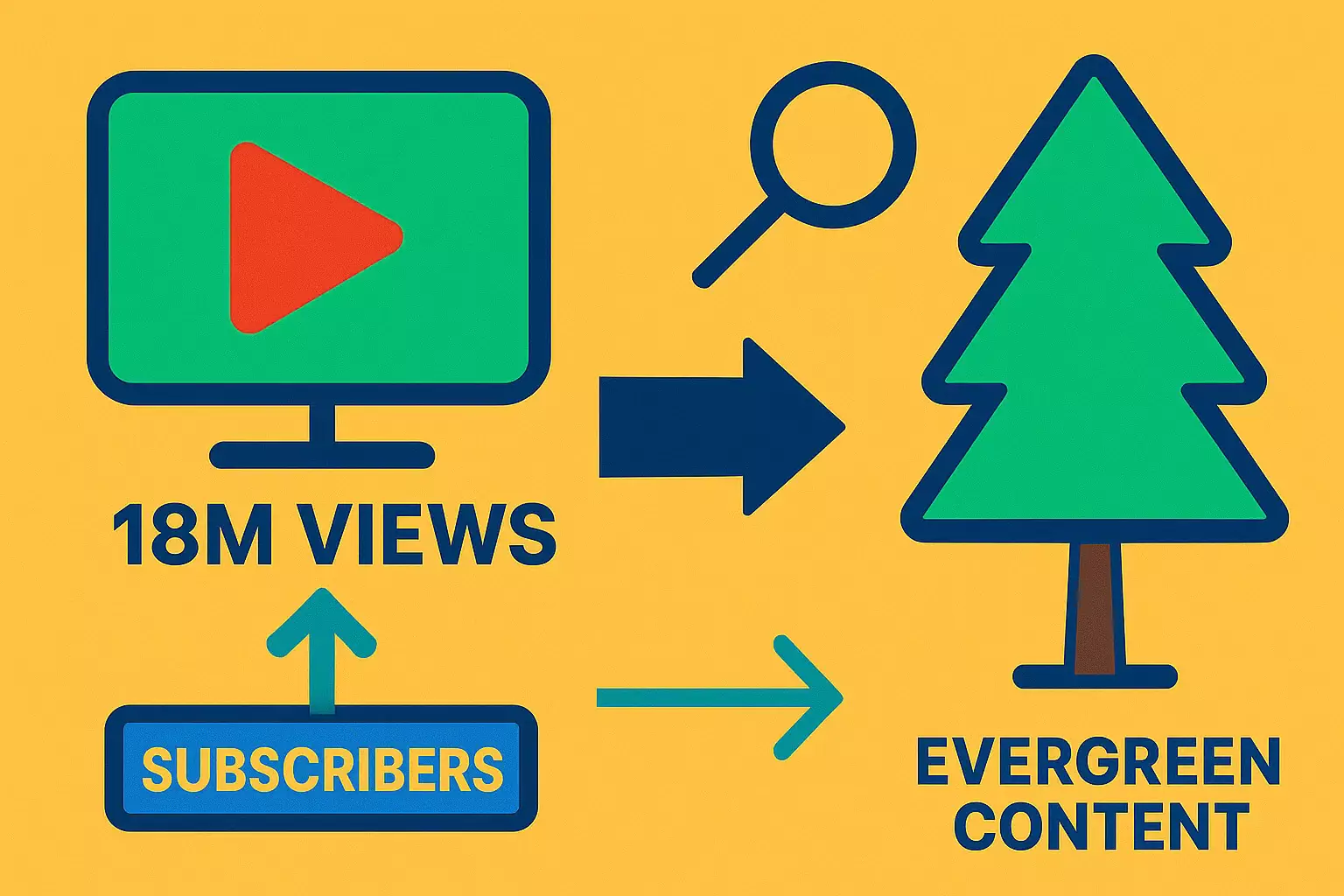
I stopped at this video because the numbers looked almost wrong.
The FeiKou channel had only 14 public videos, yet one of them—a 12-minute Baduanjin follow-along routine published in 2018—had passed 20 million views. I have made hundreds of YouTube videos across two channels, and this is exactly the kind of mismatch I like to investigate: a small library, an old upload and an audience far larger than the channel’s subscriber count.
The easy headline would be “one evergreen video can change your channel.” The more useful question is: what made this video capable of staying useful for so long, and what should a small creator actually copy?
Evidence checked August 18, 2026 (site time). Public YouTube counts keep changing, so treat the numbers below as dated snapshots.
The video kept growing
FeiKou published the routine on February 4, 2018. The Chinese title names the exercise, the instructor and the complete 12-minute format. There is very little mystery about what happens after you click: press play and follow along.

When I saved the first snapshot on September 25, 2025, YouTube displayed 18 million views. On August 18, 2026, the public video metadata showed 20,427,846. During the same period, the channel still displayed only 14 public videos; its subscriber count moved from 31.1K to 33.9K.
| Public signal | September 25, 2025 | August 18, 2026 |
|---|---|---|
| Video views | 18M displayed | 20,427,846 |
| Channel subscribers | 31.1K displayed | 33.9K displayed |
| Public videos | 14 | 14 |
| Runtime | 11:57 | 11:57 |

The first view count was rounded, so I cannot calculate a precise growth rate. But I do not need one to see the important part: this was not a seven-year-old video sitting still. It continued finding viewers.
Why this video has almost no reason to expire
I cannot see how much of the 20 million came from Search, Suggested or external websites. Only the channel owner can see that in YouTube Studio. But I can see why the video remains useful.
Baduanjin does not stop working because an app changes its interface. The routine does not depend on a product launch, a news cycle or the year in the title. Someone who wants to practise today has essentially the same job as someone who found the video in 2018.
The video also finishes the job. It is not a teaser about the benefits of Baduanjin or a list of five exercises followed by a sales pitch. The viewer can complete the full routine without leaving the page.
And the packaging is refreshingly literal. The title says what the routine is, who demonstrates it and how long it takes. The thumbnail shows the actual instructor doing the actual exercise. For a task like this, clarity is more persuasive than cleverness.
The small-channel lesson is not “wait for one miracle video”
At the second snapshot, this single video had roughly 603 times as many lifetime views as the channel’s current subscriber count. That does not mean subscribers are irrelevant, and it is not a conversion rate. It means an individual video can reach far beyond the audience a channel already owns.
YouTube’s own explanation of recommendations is helpful here: the system tries to match videos to individual viewers. It does not give every upload from a small channel one permanently small ceiling.
But I would not copy the channel’s small library as a strategy. If one durable answer works, the better move is to publish the next useful answer for the same person. A complete beginner routine might lead naturally to breathing, common mistakes, different lengths or routines for different physical constraints. That turns one discovery opportunity into a path through the channel.
My evergreen test before making a video
This case changed the questions I would ask before calling an idea “evergreen”:
- Will the same person still need this result in two or three years?
- What could make the answer obsolete? Software, products, rules and prices create maintenance work.
- Can one video finish the job? A complete answer has more reason to be saved, shared or revisited.
- Can the promise be shown plainly? The viewer should understand the task or outcome before clicking.
- Why is this the useful choice? It might be clearer, deeper, shorter, better demonstrated, available in another language or made for an underserved audience.
- What should the viewer watch next? A durable hit is more valuable when it belongs to a useful cluster.
The Evergreen YouTube Content guide turns these questions into a topic and maintenance workflow. The Get Consistent Views Guide shows how to test an opportunity with a small group of related videos instead of betting everything on one upload.
How I would check the idea in YouTube Studio
If this were my channel, I would open the video’s Reach report before telling a story about why it worked. I would record the traffic-source mix, the actual YouTube search terms and the videos sending Suggested traffic. I would also check Browse, playlists and external embeds; an old useful video can compound through several surfaces at once.
Then I would compare mature 90-day periods. Is the video still receiving impressions? Are viewers choosing it? Where does retention fall? Do returning viewers or related videos suggest a series opportunity? I would save the answers with a date and review them again next quarter.
The YouTube Analytics Guide explains that review process in detail.
What we still cannot know from the public page
This case cannot tell us whether Search was the largest source, whether the video had a first-mover advantage, or what its click-through and retention curves look like. It also cannot prove that the video held a stable ranking or that another Baduanjin upload would produce the same result. Those claims require private Analytics or historical competitive data that we do not have.
That limitation does not make the case useless. It simply makes the lesson more honest: a clearly packaged video that completes a durable task can keep earning opportunities for years, even when it comes from a very small public library.
Evergreen content does not remove uncertainty. It gives a useful video more time to earn discovery.
Sources
- FeiKou Baduanjin video — public title, upload date, runtime and view count checked August 18, 2026.
- FeiKou channel — public subscriber and video counts checked August 18, 2026.
- Two Tinyfool screenshots captured September 25, 2025 and reproduced above.
- YouTube’s Recommendation System.
- Understand your YouTube video reach.
Research note: this is a two-snapshot observation of public pages, not an audit of FeiKou’s private Analytics. Public counts can show durability; they cannot isolate the effect of topic, title, thumbnail, retention or any one discovery surface.